Use your email address to subscribe to our newsletter and we will keep you up-to-date on the latest product developments, events and seminars.




Fumed silica is a non-toxic, amorphous solid material supplied as a lightweight white powder. It is widely used in the chemical industry as a thickening and reinforcing agent in liquid systems.
Production of fumed silica
Fumed silica is produced by combusting silicon tetrachloride in a flame at extremely high temperatures, typically between 1,000°C and 2,400°C. During this process, molten silicon dioxide particles are formed which, upon cooling, aggregate into complex branched structures. The resulting material has a very low bulk density and a high specific surface area, accounting for its exceptional ability to interact with the systems into which it is incorporated.
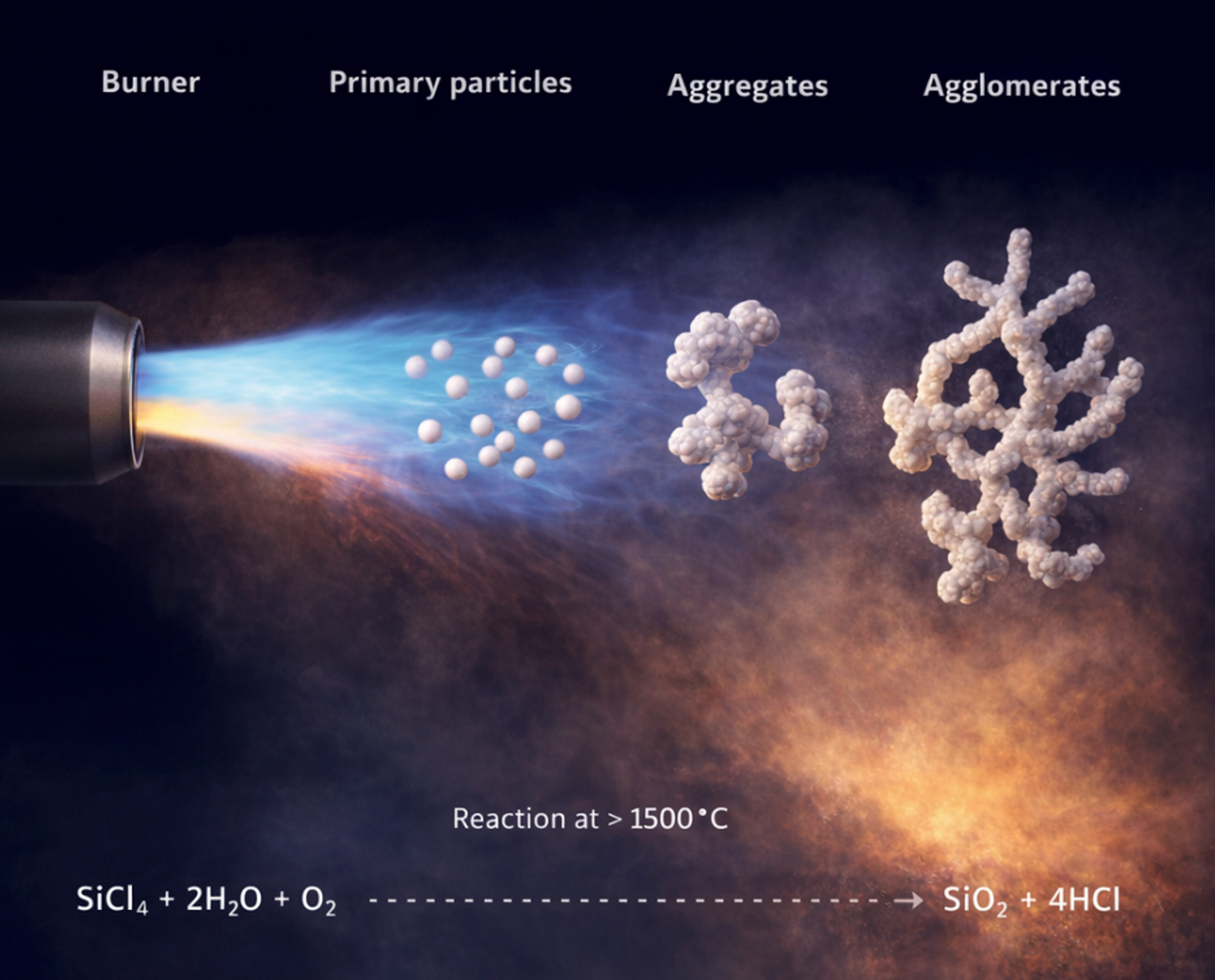
Source: Image adapted using Microsoft 365 Copilot AI
By default, fumed silica is hydrophilic, exhibiting a strong affinity for water, which makes it particularly effective for modifying the rheology of water-based systems. However, its surface can be chemically treated with methylsilanes to reduce moisture uptake and impart hydrophobic properties. These modified grades are compatible with solvent-based systems and resin formulations.
LETOP fumed silicas, marketed under the UPSIL brand, are available with particle sizes ranging from 7 to 40 nm, specific surface areas between 90 and 380 m²/g, and in both hydrophilic and hydrophobic grades
Rheology control and enhanced performance
The ability of fumed silica to modify rheology results from the formation of a three-dimensional network of hydrogen bonds between individual particles. This network restricts internal movement within the system, leading to a significant increase in viscosity.
Fumed silica also imparts thixotropic behaviour to fluids, meaning that viscosity decreases when shear is applied but recovers once the mechanical stress is removed. This behaviour results from the temporary disruption of hydrogen bonds under shear, followed by their reformation when the system returns to a static state.
When UPSIL grades are properly dispersed within the formulation, they help prevent defects such as sagging after application and the sedimentation of fillers and pigments. In specific applications, fumed silica also acts as a reinforcing agent, improving the wear and impact resistance of the finished material.
Key applications of fumed silica
As noted above, fumed silica is widely used across a broad range of industrial sectors. Its principal applications include:
At Comindex –part of IMPAG Group– we can support you throughout your process. Simply contact our team of technical sales advisors